
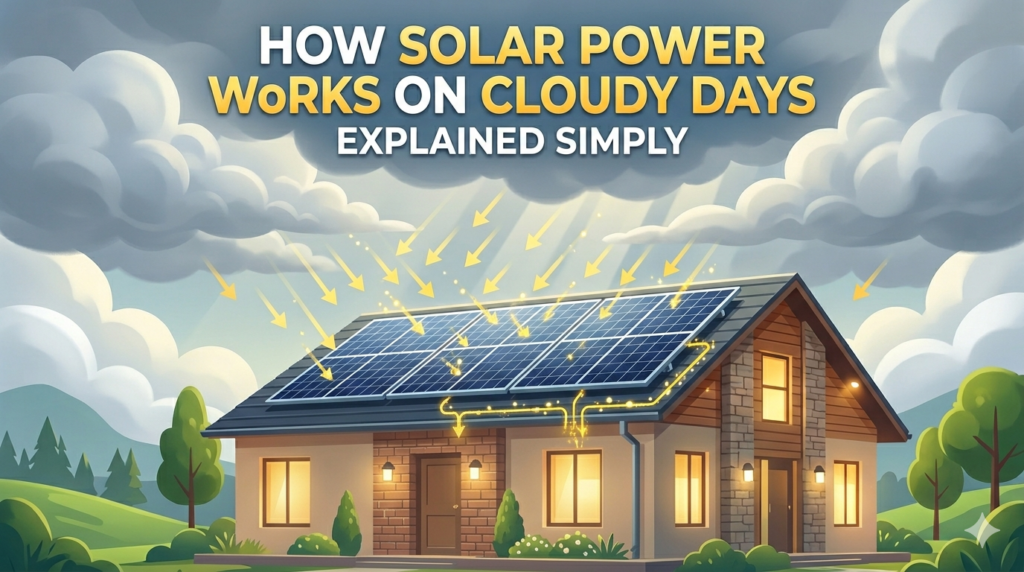
Many people believe that solar panels only work when the sun is shining brightly. But that’s not true. Solar power systems continue to generate electricity even on cloudy days. This misconception often prevents people from switching to solar energy.
In this blog, we’ll explain in a simple way how solar power works on cloudy days and why it is still a reliable choice for homes and businesses.
Understanding How Solar Panels Work
Solar panels convert sunlight into electricity using photovoltaic (PV) cells. These cells absorb sunlight and generate electrical energy, which is then converted into usable power through an inverter.
The key point to understand is that solar panels do not require direct sunlight — they only need daylight. Even on cloudy days, sunlight still reaches the earth in the form of diffused light.
What Happens on Cloudy Days?
On cloudy days, sunlight is less intense but still present. Solar panels are designed to capture both direct and indirect sunlight.
This means:
Typically, solar panels produce around 10% to 50% of their usual output on cloudy days, depending on cloud density.
Why Solar Still Works Without Direct Sunlight
Clouds do not completely block sunlight—they scatter it. This scattered (diffused) light still contains energy that solar panels can capture.
Modern solar technology is highly efficient, allowing systems to perform even in less-than-ideal weather conditions. This is why countries with limited sunshine still successfully use solar power.
How Solar Works in Cities Like Pune
In cities like Pune, where sunlight is available for most of the year, solar systems perform very efficiently.
Even during the monsoon season:
Do Solar Panels Work During Rain?
Yes, solar panels can still generate electricity during light rain, although output will be lower.
Interestingly, rain helps clean dust and dirt off the panels, improving their efficiency when sunlight returns.
What About Night Time?
Solar panels do not produce electricity at night due to the absence of sunlight. However, this is managed in two ways:
New Technologies That Improve Solar Performance
Modern solar systems come with advanced features to improve performance in all weather conditions:
Common Myths About Solar in Cloudy Weather
Myth 1: Solar panels don’t work during monsoon
Fact: They continue to generate electricity, even under cloud cover.
Myth 2: Cloudy weather makes solar useless
Fact: Solar systems are designed to work year-round in all weather conditions.
Myth 3: You won’t save money during cloudy seasons
Fact: While output may be lower temporarily, overall yearly savings remain significant.
How to Maximize Solar Efficiency in All Weather
To ensure optimal performance of your solar system:
Conclusion
Solar power remains a reliable and efficient energy solution—even on cloudy days. By capturing diffused sunlight, solar panels continue to generate electricity throughout the year.
If you are considering switching to solar energy, don’t let weather concerns hold you back. With the right system and proper installation, you can enjoy consistent savings and long-term benefits.
Contact for Reliable Solar Solutions
If you want to learn more or install a solar system, connect with:
Savemax Solar Systems Pvt. Ltd.
Address: Opp. Lane of Pooja Electronics, Manaji Nagar, Narhe, Pune, Maharashtra – 411041
Mobile No: +919730015810
Switch to solar today and start saving—rain or shine!
WhatsApp us